
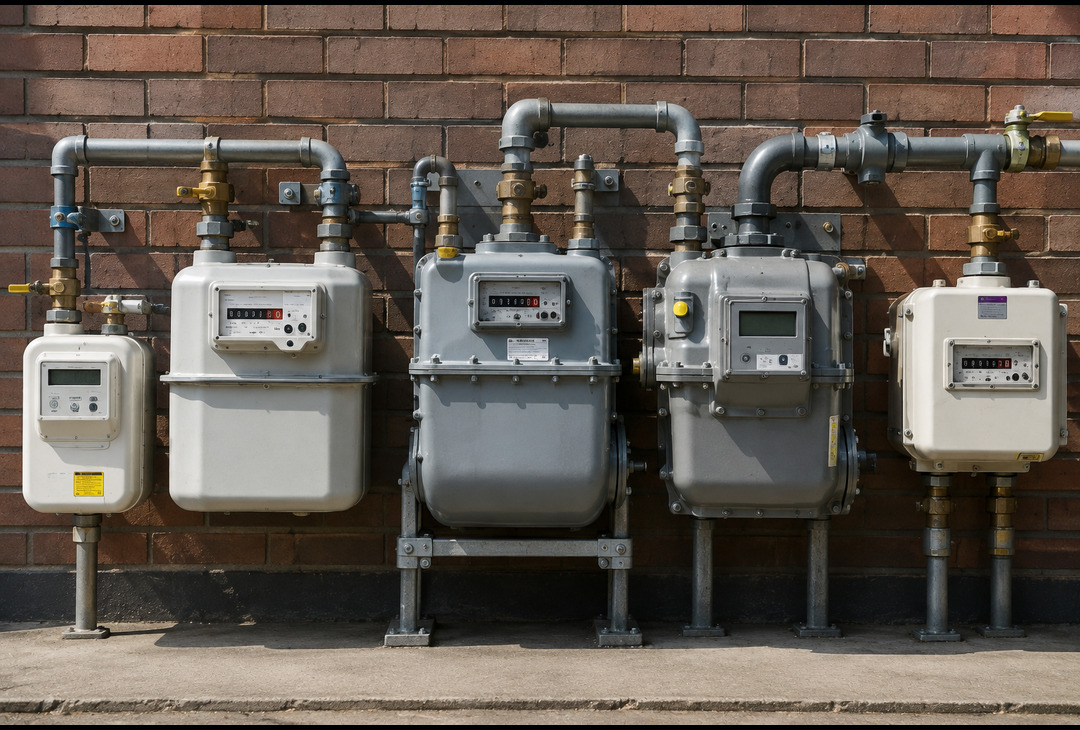
Most business owners can tell you their rent, their broadband provider, and probably their coffee order. Ask what type of gas meter sits in the cupboard out back, and you will likely get a shrug. That is completely normal. Nobody goes into business to become a meter expert.
The trouble is, your gas meter type shapes more than you might think. It affects how accurately you are billed, what business gas prices you get quoted, and how smoothly a supplier switch goes. Get asked for your meter type mid-quote and draw a blank, and the whole process grinds to a halt.
This article walks through the five main types of business gas meters in the UK, how to tell which one is fitted at your premises, and what it means for your commercial gas prices. By the end, you will be able to look at your meter and know exactly what you are looking at.
Why Your Gas Meter Type Actually Matters
A gas meter is not just a box that clicks over in the background. It is the starting point for almost every conversation you have with a supplier.
Suppliers use your meter type and size to work out which tariffs you can access, how readings are taken, and whether an engineer needs to visit before a switch can go ahead. Get it wrong on a quote form, and you risk a delayed switch or an inaccurate estimate of your business gas prices.
It also affects daily life: a diaphragm meter needs someone to read the dial, while a smart meter reports usage automatically. Knowing which one you have saves time, avoids estimated bills, and puts you in a stronger position when you compare commercial gas prices.
Where to Find Your Meter Details
Two pieces of information do most of the work here. Your Meter Point Reference Number (MPRN) is a 6 to 11 digit code that identifies your specific gas supply point. You will find it on any gas bill, usually near the top, and it is the gas equivalent of an electricity MPAN.
The meter's data badge tells you the rest. Every UK gas meter carries a small plate near the display showing a size class such as U6, U16 or U25. That single code tells a supplier almost everything they need to know about your meter's capacity.
The 5 Business Gas Meter Types Explained
Business gas meters fall into five broad categories, based on the mechanism used to measure gas flowing through them. Most small businesses only ever encounter the first one or two. A cafe might start out on a small diaphragm meter, then get upgraded to a bigger one, or even a rotary meter, as it adds catering equipment and grows.
1. Diaphragm Meters
Diaphragm meters, sometimes called credit meters, are by far the most common type on UK business premises. Inside, a set of bellows fills and empties as gas passes through, and each cycle is counted mechanically to measure volume.
If you run a small shop, salon, cafe or office with a single boiler, this is almost certainly what you have. Diaphragm meters are sized U6 or U16 in most cases, sometimes U25 for slightly heavier use. They are reliable, inexpensive to install, and simple to read, whether that is a rotating dial or a basic digital display.
The trade-off is capacity. Diaphragm meters cannot handle very high flow rates, so once gas demand grows, typically through commercial kitchen equipment or a larger heating system, it is time to step up to a rotary meter.
2. Rotary Meters
Rotary meters take over once demand outgrows a diaphragm meter, generally from around U40 upward. Instead of bellows, two geared rotors turn as gas flows past them, and the rotation count gives the volume reading.
They handle considerably higher pressure and flow than diaphragm meters while staying relatively compact, which is why many suppliers now fit rotary meters where a large diaphragm meter might once have done the job. You will typically find them in medium-sized restaurants, hotels, and light industrial units. They need periodic calibration and are usually paired with a volume corrector, a small device that adjusts readings for temperature and pressure.
3. Turbine Meters
Turbine meters are built for serious volume. Gas spins a small internal turbine or helix as it passes through, and the speed of rotation is converted into a flow reading.
These meters are reserved for large commercial and industrial sites: manufacturing plants, big hotel groups, hospitals, and any business with continuous, high volume gas use. They are accurate at high flow rates but less reliable at low ones, so they are rarely fitted near a typical small business, and are almost always installed, serviced, and read by specialists.
4. Ultrasonic Meters
Ultrasonic meters work completely differently. Instead of moving parts, they fire ultrasonic pulses through the gas and measure the tiny difference in travel time between them, which is converted into a flow rate.
With nothing mechanical to wear out, ultrasonic meters need less maintenance and stay accurate across a wide range of flow rates, from a quiet Sunday to a busy peak. That makes them a popular upgrade for larger or more complex commercial sites, though they remain less common than diaphragm or rotary meters on typical high street premises.
5. Smart Gas Meters (SMETS2)
A smart meter is not really a different measuring mechanism; it is a communication upgrade. Many smart business gas meters are diaphragm meters underneath, fitted with a module that sends readings straight to your supplier, usually daily.
The benefit is straightforward: no more estimated bills, no chasing manual readings, and a clearer picture of your actual consumption. If your business uses a modest amount of gas, a shop, office, or small cafe, for example, there is a good chance you are already eligible for one at no extra cost. It is always worth asking your supplier directly.
Type | How it works | Typical user | Best for |
|---|---|---|---|
Diaphragm | Bellows fill and empty; cycles counted | Shops, salons, small offices | Low to moderate gas use |
Rotary | Twin geared rotors count rotations | Restaurants, hotels, light industry | Medium, growing gas demand |
Turbine | Spinning turbine measures gas velocity | Factories, large hotels, hospitals | High, continuous volume use |
Ultrasonic | Sound pulses measure flow, no moving parts | Larger or variable-demand sites | Accuracy across wide flow ranges |
Smart (SMETS2) | Automatic digital reading and reporting | Any size, increasingly standard | Accurate, hassle-free billing |
A quick reference for the five main business gas meter types found on UK premises.
How to Identify Which Gas Meter You Have
If you are still not sure which type is fitted at your premises, a couple of quick checks will usually tell you.
Check the Size Label
Look for the data badge near the meter's display. It shows a size class written as a U-number, often alongside a European G-number equivalent. That number is the meter's maximum flow in cubic metres of gas per hour, and it is a fair guide to what kind of business typically has one.

U-number (G-equivalent) | Typically suits |
|---|---|
U6 (G4) | Small shop, office, hairdresser |
U16 (G10) | Cafe, medium shop, small restaurant |
U25 (G16) | Restaurant, small hotel, small factory |
U40 and above | Larger commercial and industrial sites |
Imperial or Metric? Read the Display
The other quick clue is how your meter displays its reading. An imperial meter shows four digits followed by ft³, gas measured in cubic feet, and often looks like an old car odometer with rotating dials. A metric meter shows five digits followed by a decimal point and m³, gas measured in cubic metres.
Neither type is better or worse, and both are perfectly billable, but if you are ever asked to read your own meter, knowing which one you are looking at means you note down the right digits rather than guessing. As a rule of thumb, older meters are more likely to be imperial, and most modern replacements are metric.
Quick tip: can't get near the meter, or the badge is worn away? Your MPRN and meter details are on any recent gas bill. If you cannot find one, your supplier can look it up from your business address in a couple of minutes. |
How Your Gas Meter Affects Your Business Gas Prices
Your meter does not set your business gas prices directly; your supplier and the wholesale market do that, but it shapes the quote you are offered in a few real ways.
Larger meters generally mean lower unit rates. Businesses on bigger diaphragm, rotary, or turbine meters typically use more gas overall, and suppliers reward that volume with a lower price per kWh, usually alongside a higher standing charge.
Reading method affects billing accuracy. A smart meter reports actual usage, while an older diaphragm meter relies on manual or estimated reads between visits, which can lead to bill shocks when a true reading catches up.
Meter size affects VAT and levy treatment. Businesses using less than 145 kWh of gas a day may qualify for reduced 5% VAT and an exemption from the Climate Change Levy, currently 0.801p per kWh, instead of the standard 20% rate most businesses pay.
Usage band | Typical annual usage | Typical unit rate* | Typical standing charge* |
|---|---|---|---|
Micro or small | Up to 25,000 kWh | 7.5p to 9p per kWh | 20p to 40p per day |
Medium | 25,000 to 75,000 kWh | 6.5p to 7.5p per kWh | 25p to 50p per day |
Large | 75,000 kWh and above | 5p to 6.5p per kWh | 30p to 60p per day |
*Indicative UK averages for 2026, excluding VAT. Actual commercial gas prices depend on postcode, contract length, credit position and supplier.
Practical Tips for Getting an Accurate Business Gas Quote
A little preparation gets you a faster, more accurate quote and stops you overpaying while you wait.
Have your MPRN ready. It is on any recent bill and is the fastest way for a supplier to pull up your exact supply details.
Note your meter's U-number. It tells a supplier your capacity band before they even see a bill.
Submit a real reading, not an estimate, whenever you request a quote or switch, to avoid a messy true-up later.
Ask about a smart meter upgrade if you are still reading a dial by hand. Most suppliers fit them free for eligible businesses.
Compare unit rate and standing charge together. A lower headline rate with a high standing charge can cost more over a year than a slightly higher rate with a modest daily fee.
Check your renewal window. Business gas contracts generally cannot be switched until one to six months before the end date, so mark it in the diary.
Frequently Asked Questions
What is an MPRN, and where do I find mine?
An MPRN (Meter Point Reference Number) is a 6 to 11 digit code that identifies your gas supply point. It appears on any recent gas bill, and your supplier can also look it up using your business address.
Can I choose which type of gas meter I have?
Not really. Your premises' gas demand determines your meter type and size, worked out from your appliances and expected usage, rather than personal preference.
Is a smart gas meter free to install?
In most cases, yes. Suppliers generally offer smart meter upgrades at no cost to eligible business customers as part of the wider rollout.
How do I read an imperial gas meter?
Note the first four digits shown, ignoring anything after a decimal point or shown in red. Your supplier converts this into kWh for billing using your bill's calorific value.
Does my meter type affect switching suppliers?
It can affect timing. Small diaphragm and smart meters switch quickly with no site visit. Larger rotary or turbine meters occasionally need an engineer to confirm capacity first.
What if my meter looks old or the badge is unreadable?
Your supplier can identify it from your MPRN and consumption history, so there is no need to guess. It is still worth asking about a free upgrade while you are in touch.
Final Words
Understanding your gas meter is not exciting, but it is one of those small pieces of knowledge that makes everything else easier: quotes go faster, bills make more sense, and switching supplier stops feeling like a guessing game.
Take five minutes to find your meter's data badge and your MPRN. Once you know whether you are looking at a diaphragm, rotary, turbine, ultrasonic, or smart meter, you are in a far stronger position to compare business gas prices properly, rather than accepting whatever your current supplier rolls you onto.
If you would rather skip the legwork, SwitchUrEnergy compares commercial gas prices from trusted UK suppliers and handles the switch for you, at no cost.
Ready to see what your business could be paying? Get a free, no-obligation gas quote from SwitchUrEnergy today.