
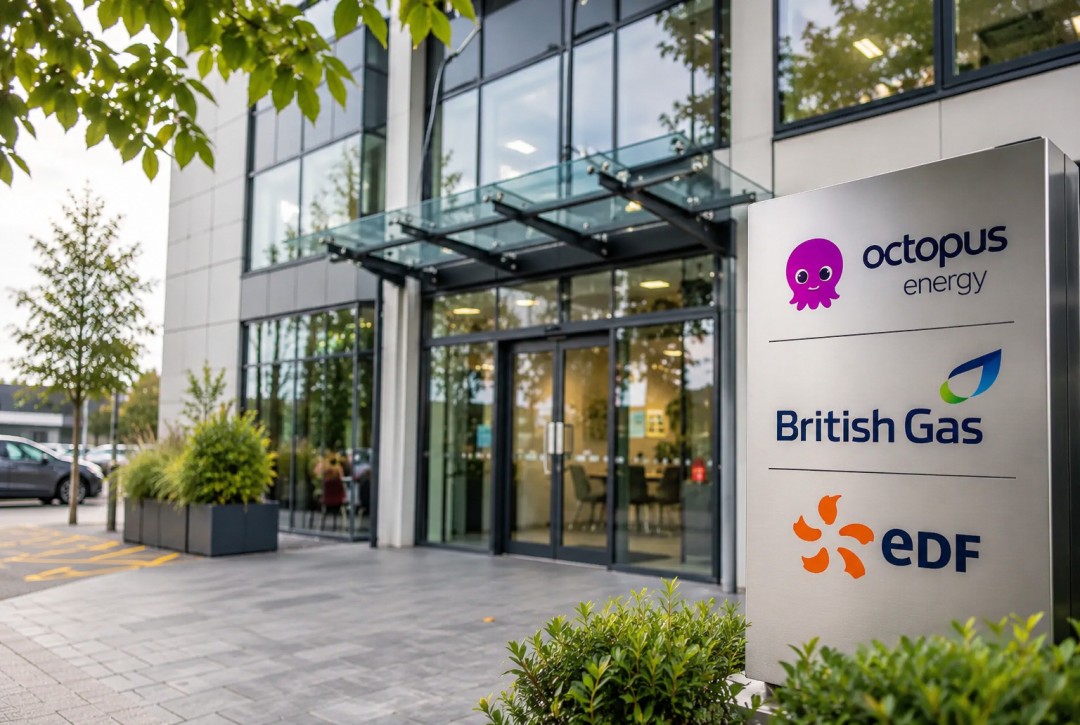
When a business starts looking at commercial electricity suppliers, three names come up again and again. Octopus Energy, British Gas and EDF each have a large customer base, a strong brand and a business offer. On the surface, they can look interchangeable. In practice, they're built for different kinds of business.
The right choice depends on your usage pattern, your appetite for risk, how much support you need and whether your site can shift energy away from peak hours. A cheap headline rate from one supplier can cost more over a year than a slightly higher rate from another, once standing charges, contract terms and service are taken into account.
This article compares the three suppliers using the independent reviews and product information available, explains the price ranges that businesses are seeing in 2026, and shows how to build a like-for-like business electricity quote so you can make the decision on your own numbers.
Quick answer Octopus Energy suits flexible, tech-ready businesses that can shift usage or run EV fleets and on-site generation. British Gas suits businesses that prioritise stability, engineering support and zero-carbon electricity, but its independent service scores are weaker. EDF suits businesses that want longer fixed terms and a supply partly backed by its own nuclear generation, with fixed contracts that can carry exit fees. |
The Three Offers at a Glance
Table 1 summarises the main products and the points to check on each. It's a starting point for your shortlist, not a replacement for reading the contract.
Supplier | Main business products | Standout feature | Watch for |
|---|---|---|---|
Octopus Energy | Flexible, fixed 12 to 36 months, Shape Shifters time-of-use and half-hourly tariffs | Smart and time-of-use tools, EV products and on-site generation tariffs | Advance payment on some profiles; smart tariffs need a smart meter |
British Gas | Fixed 1 to 4 years, variable and rolling plans, British Gas Lite for smaller users | Zero Carbon electricity included, nationwide engineer network | Exit fees on fixed contracts; no cooling-off period |
EDF Energy | Fixed 1 to 4 years, Fixed Online Zero Standing Charge, Freedom variable tariffs | Longer fixed terms and partial nuclear backing | Exit fees on fixed tariffs; standard fixed tariff not fully renewable |
Sources: Business Comparison review of Octopus Energy for business, Business Comparison review of British Gas for business and Business Comparison review of EDF Energy for business.
Octopus Energy for Business
Octopus has the widest range of the three, and its business products lean towards flexibility. Its Business Fixed contracts run for 12, 24 or 36 months, while the Shape Shifters products combine time-of-use pricing with a fixed structure. Octopus says the Trio tariff offers 21 hours of cheaper electricity every day, which matters for businesses that can move heavy loads out of the afternoon peak.
Where Octopus stands out
A broad menu, including half-hourly and export tariffs for businesses with on-site generation.
Strong independent service signals. Its business page carries a Trustpilot score based on about 250 business reviews, and the wider brand scores highly on Trustpilot.
A no-standing-charge trial on a 12-month fixed deal for eligible electricity bands, which can suit low-usage sites.
What to check
Smart tariffs need a smart meter, a clean Direct Debit record and real flexibility in your load.
Advance payment can reach about three months' estimated cost, rising to six months depending on credit score.
Citizens Advice scores were lower for billing and metering accuracy than for other measures, so check your first bills carefully.
Octopus is described as strong for most SMEs and sole traders, especially those who can shift usage. Very high-usage businesses may find better terms elsewhere, and a wide product range takes more effort to compare.
British Gas Business
British Gas positions itself on stability and support. It is part of the FTSE 100 group Centrica, and it has a nationwide engineer network and account management for larger customers. Its Fixed Price Energy Plan runs for one to four years, with Zero Carbon electricity included as standard.
Where British Gas stands out
Zero Carbon electricity at no extra cost, though it blends renewables with nuclear rather than being fully renewable.
A wide range, from smaller businesses through to bespoke contracts for organisations using over 1GWh a year.
Variable and rolling plans that take effect when a fixed contract ends without renewal, with 30 days' notice of rate changes and no exit fees.
What to check
Business contracts have no statutory cooling-off period, so read the terms before you sign.
Fixed contracts typically carry exit fees set in each contract. The review cites a typical market range of £60 to £150 per fuel, which isn't a British Gas figure.
Independent service scores are weaker than the brand's consumer reputation suggests. Citizens Advice ranked it low for the period October to December 2025, and Which? noted complaint handling and switching as weak points.
British Gas suits businesses that prioritise stability and engineering support. If service quality or the lowest price is your main concern, compare alternatives first.
EDF Energy Business
EDF offers some of the longest fixed terms in the market, with contracts running up to four years. Its Fixed Online Zero Standing Charge tariff suits low, spiky or seasonal usage, and its Fixed Renewable Tariff is backed by renewable certificates on the same term structure.
Where EDF stands out
Fixed terms of up to four years for businesses that want longer price certainty.
Freedom variable tariffs with no exit fees, plus export tariffs for on-site generation.
A dedicated small business team and a reported strong Trustpilot score across domestic and business feedback.
What to check
Fixed tariffs carry exit fees if you leave early, and the standard fixed tariff is not fully renewable.
Deemed and extended supply rates are the most expensive EDF offers. Broker estimates put them in the mid-30s p/kWh, so diarise your renewal date.
Independent service signals are weaker than the Trustpilot score suggests. Citizens Advice ranked EDF 11th of 16 for January to March 2026, and Which? did not recommend it.
EDF suits businesses that want longer price certainty and a supply partly backed by nuclear generation, especially if they're in the mid-sized usage bands. Service-focused buyers may want to compare alternatives.
What Business Electricity Rates Look Like in 2026
Business electricity rates vary with postcode, meter type, contract length and usage, so no supplier publishes a single price list. The ranges below come from the sources available to us and should be read as indicative only. They are not quotes, and they will not match your own offer.
Source | Electricity (p/kWh) | Gas (p/kWh) | Standing charge (p/day) |
|---|---|---|---|
Octopus indicative 2026 fixed rates, under 50,000 kWh | 24 to 28 | 6 to 9 | Typically 40 to 60 (electricity) |
Octopus indicative 2026 fixed rates, 50,000 to 250,000 kWh | 19 to 23 | 6 to 9 | Typically 40 to 60 (electricity) |
British Gas, wider 2026 market range | 22 to 30 | 6.5 to 9 | Not stated |
EDF, broker data checked August 2026, under 50,000 kWh | 23 to 28 | 6 to 9 | 40 to 60 (electricity), 28 to 42 (gas) |
Sources: Business Comparison review of Octopus Energy for business and Business Comparison review of British Gas for business. EDF figures are from the EDF review linked in the Sources section below.
Two points stand out. First, the ranges overlap heavily, so the supplier name matters less than the specific offer you're quoted. Second, standing charges can change the ranking. A supplier with a lower unit rate but a higher standing charge may cost more for a low-usage site.
Service and Reputation: What the Scores Say
Independent service scores differ by measure and by time period, so they're not directly comparable. Table 3 shows what each source reports. Treat it as a signal to investigate, not a verdict.
Measure | Octopus Energy | British Gas | EDF Energy |
|---|---|---|---|
Trustpilot (brand level) | 4.8 out of 5 across all Octopus services | 4.4 out of 5 for the main brand | 4.8 out of 5 across domestic and business |
Citizens Advice score | 3.78 out of 5, ranked 3rd (October to December 2025) | 2.28 out of 5, ranked 14th of 16 (October to December 2025) | 2.90 out of 5, ranked 11th of 16 (January to March 2026) |
Which? status | Recommended Provider for eight years as of 2025 | Third from bottom in 2026 survey, not recommended | Not a Recommended Provider |
Sources: Business Comparison review of Octopus Energy for business, Business Comparison review of British Gas for business and Business Comparison review of EDF Energy for business.
Octopus has the strongest independent signals in this set, while British Gas and EDF show weaker results on the Citizens Advice and Which? measures. That doesn't make either a bad supplier for every business, but it does mean you should check how each one handles billing questions and complaints before you commit.
How to Turn These Suppliers into a Real Business Electricity Quote
Comparing suppliers is only useful if you compare like with like. Start by gathering the basics, then request quotes on the same usage and term so the figures are directly comparable. Your electricity meter point number (MPAN), 12 months of bills and your contract end date are the essentials.
Table 4 shows an illustrative comparison for a site using 40,000 kWh a year, with figures before VAT. The three quotes are invented for the example, but the method is the one to use on real offers.
Illustrative quote | Unit rate | Standing charge | Annual cost (ex VAT) |
|---|---|---|---|
Quote A | 24p/kWh | 60p/day | £9,819 |
Quote B | 27p/kWh | 40p/day | £10,946 |
Quote C | 25.5p/kWh | 55p/day | £10,401 |
Quote A has the lowest unit rate and the highest standing charge, but it still comes out cheapest over the year. Quote B has the highest unit rate, and although it has the lowest standing charge, it is the most expensive of the three at this usage. Quote C sits in the middle. The lesson is clear: never rank quotes on the unit rate or the standing charge alone.
Checklist before you compare
Confirm whether each quote includes VAT, network charges and the Climate Change Levy.
Check the contract length, exit fee, notice period and what happens at renewal.
Ask whether the quote is fixed or variable, and what changes might apply during the term.
Check the payment terms, including any advance payment required.
Ask each supplier how it handles billing queries and complaints.
How SwitchUrEnergy Can Help
SwitchUrEnergy compares business electricity quotes from several suppliers in one place, so you can see Octopus, British Gas and EDF alongside other options rather than relying on a single supplier's offer. You can begin at SwitchUrEnergy by sharing your MPAN, your last 12 months of bills and your contract end date.
With those details, we can help you compare the full annual cost of each quote on the same basis, check the terms that matter most, and plan a switch around your renewal window. The choice remains yours, and it's based on your own numbers.
Frequently Asked Questions
Here are answers to the questions we hear most often.
Which is the best commercial electricity supplier for a small business?
There isn't a single best supplier for every business. Octopus suits flexible, tech-ready businesses, British Gas suits stability and support, and EDF suits longer fixed terms. Compare quotes on the same basis before deciding.
Are these three suppliers more expensive than smaller challengers?
Not necessarily. Indicative 2026 ranges overlap heavily, so a smaller supplier can be cheaper, but it may carry more financial risk. Check the supplier's stability and terms alongside the price.
Do business customers get a cooling-off period?
Generally, not. Business contracts have no statutory cooling-off period, so read the terms carefully before you sign.
What happens if my contract ends without a new deal?
You may move onto a deemed or variable rate, which is often the most expensive option. Start your comparison well before the renewal window opens to avoid this.
Can I use a broker instead?
A broker can give you access to more suppliers, but brokers are usually paid commission, which may be built into the rate. Ask for the commission in writing for every quote.
Final Words
Octopus, British Gas and EDF each have a clear business proposition. Octopus is the most flexible of the three and has the strongest independent service signals in this group. British Gas offers stability, zero-carbon electricity and engineering support. EDF offers longer fixed terms and partial nuclear backing.
None of them is automatically the right answer. The right answer is the quote that gives you the lowest full annual cost on terms you can live with, from a supplier whose service you trust. You can start that comparison with SwitchUrEnergy whenever you're ready.