
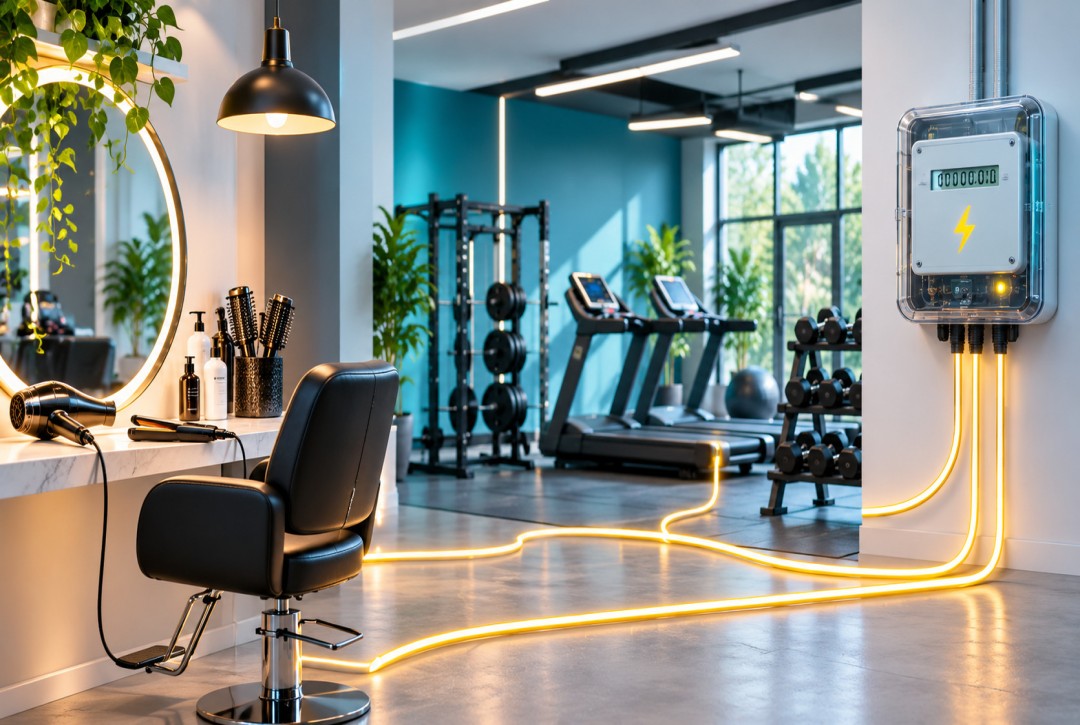
It is 8:15 am on a Tuesday. The first client is in the chair, the dryers are roaring, and the water heater is working flat out. Across town, a gym owner unlocks the doors and the lights; treadmills and air conditioning all spring to life. Neither of them is thinking about their electricity contract. Both should be.
Salons and gyms use more power than many small premises, and unlike households, they are not covered by the Ofgem price cap. What you pay comes down to your contract, your usage and how hard you shop around. This article shows what salons and gyms really pay in 2026, how to compare business electricity suppliers, and where the savings hide.
Quick answer
Small businesses pay around 29.5p per kWh in November 2026, plus a daily standing charge.
A three-chair salon could pay about £5,900 a year before VAT, and a 24-hour boutique gym can pay £23,000.
Start comparing three to six months before your contract ends.
What do salons and gyms pay for electricity in 2026?
Start with the market. Panel data from Bionic, reported by MoneySuperMarket, put average business electricity unit rates between 29.1p and 29.9p per kWh in early November 2026. Here is how that looks by business size.
Business size | Annual usage | Unit rate | Standing charge | Average annual bill |
|---|---|---|---|---|
Micro | 5,000 to 15,000 kWh | 29.1p | 125.4p a day | £3,368 |
Small | 15,001 to 25,000 kWh | 29.5p | 157.4p a day | £6,475 |
Medium | 25,001 to 55,000 kWh | 29.9p | 378.6p a day | £13,342 |
Large | Over 55,000 kWh | 29.9p | 467.4p a day | £18,151 |
Source: MoneySuperMarket and Bionic panel averages, 1 to 9 November 2026. The bills work out at roughly 10,000, 20,000, 40,000 and 55,000 kWh a year. Quotes are normally shown before VAT, so check yours.

Average annual business electricity bills: Rising from £3,368 for micro businesses to £18,151 for large businesses in November 2026.
Most salons sit in the micro or small bands, while gyms usually land in the medium or large bands.
How much electricity do salons and gyms use?
Usage is the other half of the sum. These industry estimates from EnergyCosts.co.uk and its gym guide give a rough guide.
Premises | Electricity per month | Roughly per year |
|---|---|---|
Boutique hair salon (1 to 3 chairs) | 800 to 2,000 kWh | 9,600 to 24,000 kWh |
Mid-size hair salon (4 to 8 chairs) | 2,000 to 4,500 kWh | 24,000 to 54,000 kWh |
Small gym or studio | 5,000 to 7,500 kWh | 60,000 to 90,000 kWh |
Your own bills beat any benchmark, so pull out the last 12 months before you ask for quotes.
What drives your bill beyond the unit rate?
Standing charge. This is the daily fee for being connected. At 125.4p a day, a micro business pays about £458 a year before using a single unit, so always compare the unit rate and standing charge together.
VAT and CCL. Most salons and gyms pay 20% VAT, plus CCL at 0.801p per kWh since 1 April 2026. Reduced-rate VAT only covers very small supplies, roughly 33 kWh a day at one premises, and a temporary zero rate applies to qualifying electricity in Great Britain until 31 March 2027. A tiny studio might qualify. Most salons and nearly every gym will not, so ask your supplier to confirm.
Contract type. This often matters more than the supplier. A fixed contract locks in your unit rate and standing charge for its term. Out-of-contract and deemed rates are usually dearer, and some contracts roll over automatically. Ofgem also notes there is no cooling-off period once you sign. Most salons count as micro businesses (fewer than 10 employees and turnover up to £2 million, or up to 100,000 kWh a year), which brings extra protections such as clear renewal price information.
Meters and opening hours. A smart meter ends estimated bills and shows when you use power. Sites above 100 kW peak demand need a half-hourly meter, which allows more tailored pricing, and gyms open overnight may suit a time-of-use tariff.
Where does the electricity go in salons and gyms?
Salons. Opinions differ on the biggest drain. One industry guide puts styling tools first, while University of Southampton research with 20 salon owners found that heating water uses more energy than hair drying. Its sustainable salon practices, such as tepid water and shampooing once, could save an average four-seat salon 24,150 kWh a year, worth £5,300 when the study was published. At 29.5p per kWh, typical kit costs this to run:
Equipment | Typical draw | Cost per hour in use |
|---|---|---|
Hairdryer | 1.5 to 2.0 kW | 44p to 59p |
Straighteners or tongs | 0.6 to 1.0 kW | 18p to 30p |
Electric water heater | 3.0 to 5.0 kW | 89p to £1.48 |
Washer-dryer | 1.2 to 2.5 kW | 35p to 74p |
Typical draw from EnergyCosts.co.uk. Costs are our calculation at 29.5p per kWh and maximum draw, which appliances rarely hold for a full hour.
Gyms. Cardio kit, lighting that can run 12 to 18 hours a day, ventilation and showers all add up, and one guide ranks heating and cooling as the highest cost for most gyms. An independent gym backed by the West of England Combined Authority estimated a cut of more than 40% in electricity use after fitting LED lighting and double glazing.
How to compare business electricity suppliers
A good comparison looks beyond the headline rate. Check the unit rate and standing charge together, plus contract length, exit fees, renewal terms, smart meter support and how easy the supplier is to reach when a bill looks wrong.
Where does Octopus electricity fit in?
Octopus Energy says it supplies more than 100,000 businesses. It offers fixed tariffs for up to two years, plus smart tariffs such as Shape Shifters, which reward you for using less power between 4 pm and 7 pm. Octopus says it does not work with brokers or comparison sites, so you need to request Octopus electricity quotes directly. Treat that quote as a benchmark against the panel quotes you receive. Shifting away from 4 pm to 7 pm suits sites that are busiest in the morning or overnight, but it may be harder for gyms and salons packed after work.
Suppliers you can compare through us
We compare a wide network of licensed business electricity suppliers, though not every provider. Here is how some stack up, using indicative prices from our electricity comparison table.
Supplier | Worth knowing | Indicative annual bill* |
Strong focus on smart meters and usage data | £2,829 (3-year fixed) | |
British Gas Lite | Among our lowest prices in August | £2,840 (3-year fixed) |
PeakSave for Business helps eligible customers use more power in lower-demand hours | £2,993 (3-year fixed) | |
Yu Energy | Fixed-rate plans | £3,217 (2-year fixed) |
One, two or three year deals, renewable electricity as standard | Personalised quote | |
Octopus Energy | Sold direct only, see above | Quote direct from Octopus |
*Estimated annual bill for 10,000 kWh (7,000 day, 3,000 night) before VAT, as shown on our comparison table on 11 August 2026. Indicative only.
Two worked examples
Numbers beat theory, so here are two illustrations. They use the November averages above and are indicative, not quotes.
Example 1: a three-chair hair salon using 18,000 kWh a year
On a fixed deal at small-business averages, this salon pays about £5,885 a year before VAT. If its contract ends and it rolls onto out-of-contract rates, the bill jumps.
Deal | Unit cost | Standing charge | Annual total |
|---|---|---|---|
Fixed (29.5p, 157.4p a day) | £5,310 | £575 | £5,885 |
Out of contract (40p, 254p a day) | £7,200 | £927 | £8,127 |
The out-of-contract rates are the latest we found, from MoneySuperMarket's August 2026 price update. The gap is about £2,242 a year before VAT. One missed renewal date, and that money disappears.
Example 2: a 24-hour boutique gym using 72,000 kWh a year
At large-business averages (29.9p and 467.4p a day), this gym pays about £23,234 before VAT, and a half-hourly meter is likely at this size. See what two levers do.
Scenario | Annual cost | Saving |
|---|---|---|
Baseline | £23,234 | None |
5% lower unit rate | £22,154 | £1,080 |
10% less usage | £21,081 | £2,153 |
Both together | £20,109 | £3,125 |

Bar chart showing a 24-hour gym's annual electricity cost falling from £23,234 to £20,109 when a lower unit rate and 10% less usage are combined.
The lesson is simple. Price and usage are separate levers, so pull both.
Seven ways to cut your electricity bill
Diary your renewal. Ofgem says fixed contracts have a switching window that opens a few months before the end date. Set a reminder for six months out.
Ask for a smart meter. Smart meter data shows what runs overnight, such as CCTV, fridges and standby kit.
Switch to LEDs. Lighting is a big load in both salons and gyms, as the Phase One example showed.
Time your hot water. Put heaters on timers, keeping stored water hot enough to control legionella, and try tepid water at the basin.
Switch things off. Tools between clients, idle cardio kit and screens after closing all add up.
Service heating and cooling. Well-maintained systems run more efficiently, and even a 1°C thermostat change can make a noticeable difference.
Plan for new premises. Arrange a contract before you get the keys, or you may land on a deemed rate, which is usually higher.
How Switch Ur Energy helps
We are a UK energy services platform that helps businesses compare electricity suppliers, gas and water in one place, and we have supported more than 950 UK businesses. For salons and gyms, it works in three steps:
Tell us about your premises, usage and current contract.
Compare personalised quotes from our supplier panel side by side.
Choose a deal and we handle the switch, which typically takes two to four weeks.
Our comparison is free because suppliers pay us when you switch, and we show the contract term and any exit fees before you commit. A Letter of Authority lets us talk to suppliers for you, but we cannot sign a contract without your consent. We also have local pages for Leeds, London, Manchester and Birmingham.
Get your free quote or call (0203) 9500885, Monday to Friday, 9 am to 5 pm.
Frequently Asked Questions (FAQs)
Here are answers to the questions we hear most often.
Which business electricity supplier is best for a salon or gym?
No single supplier wins for everyone. The best deal depends on your usage, postcode, meter and contract length, so compare several quotes rather than trusting an average.
How much does a small salon pay per month?
A three-chair salon using about 1,500 kWh a month would pay roughly £490 before VAT at current small-business averages. Spa-style salons and gyms pay far more.
Can I switch if I am still in contract?
Usually not without an exit fee, though a switching window opens a few months before your end date. Out-of-contract customers can switch at any time. Our switching timeline explains what to expect.
Does the price cap protect my salon or gym?
No. The Ofgem cap covers households, not most businesses. Our guide to the price cap and business rates explains the upcoming January 2027 announcement.
Do salons and gyms pay 5% VAT on electricity?
Usually, they pay 20%. Reduced or temporary zero rates apply only to very small supplies, roughly 33 kWh a day at one site, so confirm with your supplier or HMRC.
I run my salon from home. Do I need a business tariff?
Often you are on a domestic contract, so check with your supplier. Our guide to home-based businesses explains the rules.
Can I compare Octopus electricity through Switch Ur Energy?
Octopus sells to businesses directly and says it avoids comparison sites, so it is not currently on our panel. Request an Octopus quote yourself and set it beside ours.
Final Words
Salons and gyms run on electricity, and the right contract can protect your margins as much as a full diary or a busy timetable. Know your usage, watch your renewal date and compare more than one quote. Whether you land with a supplier from our panel or a direct deal such as Octopus, the winner is the contract you chose deliberately, not the one you rolled onto by accident. Ready to see what your business could pay? Get a free quote from Switch Ur Energy and compare business electricity suppliers and other UK energy services in minutes.