
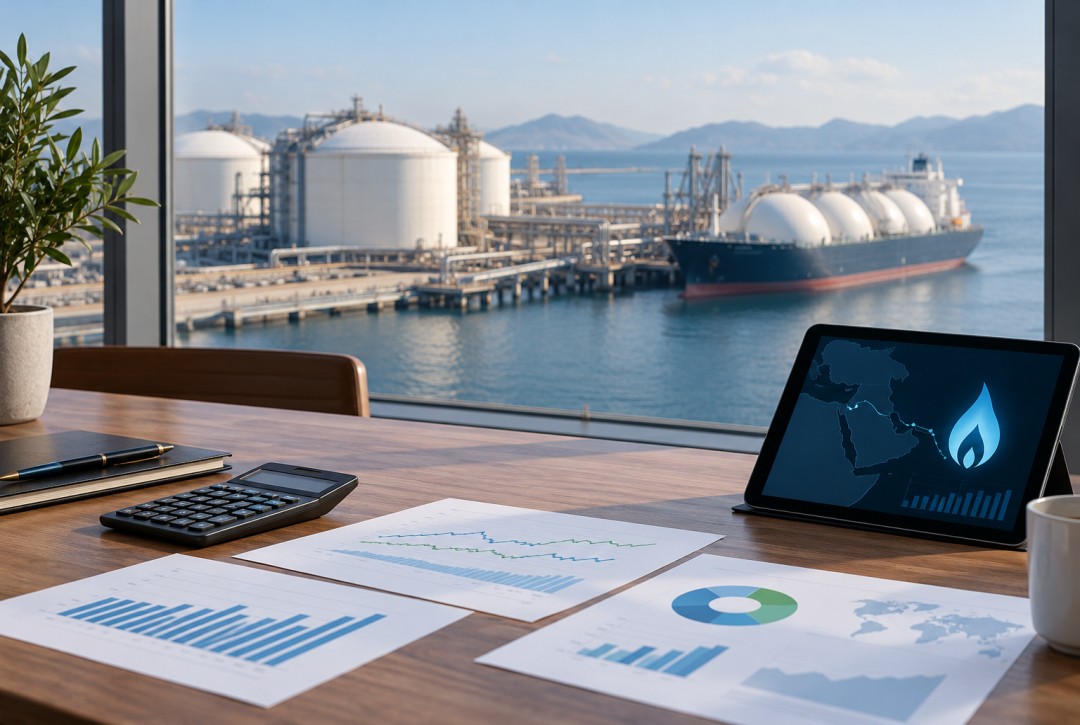
If your gas quote feels as though it is being set on the other side of the world, you are not imagining it. Since the Gulf conflict began on 28 February, one narrow strait has shaped what British businesses are asked to pay for gas, and the effects keep arriving at renewal time.
The chain is simple once you see it. Liquefied Natural Gas (LNG) from Qatar and the UAE has been choked at the Strait of Hormuz. Buyers in Asia and Europe now chase the same cargoes from elsewhere, and the UK natural gas price, traded at the National Balancing Point (NBP), moves with them. Unlike households, businesses have no price cap to soften the blow.
This article explains the mechanics in plain English, shows where prices stand in October 2026, and turns it into decisions about fixed energy deals, timing and choosing the best energy company for your site.
The Key Points
About a fifth of the world's LNG normally passes through Hormuz, and shipments are still around 80% below February levels.
Gas for this winter trades near 184p a therm, roughly 6.3p per kWh before network costs, levies and supplier margin.
A small business's average one-year fixed gas rate is about 10.4p per kWh, against 6.36p across 2025.
The market prices later periods far lower, so the term you fix for matters as much as the day you sign.
How LNG and the Strait of Hormuz reach your bill
The Strait of Hormuz links the Persian Gulf with the open sea, and there is no alternative route for the LNG that leaves it. According to the IEA, over 110 billion cubic metres passed through in 2025, including about 93% of Qatar's LNG exports and 96% of the UAE's. Since 1 March, shipments from the two countries have fallen by more than 300 million cubic metres a day.
Almost 90% of that LNG normally went to Asia, so why should Britain care? Because losing it forces Asian buyers into the open market. Other producers have replaced about three quarters of the shortfall, but every cargo now has more bidders. Bloomberg reported on 2 October that Qatar had extended force majeure to Asian customers until November and to European customers until December, and that Jera, the world's largest LNG buyer, does not expect Qatari supply to return soon.
Why Britain feels it
Norwegian pipelines are Britain's largest single source of gas, according to Catalyst Commercial, but the UK also competes globally for LNG cargoes, which makes the NBP price sensitive to events abroad. Our September guide to the Ofgem cap adds the storage point: Britain holds around ten days of demand, against roughly 90 in Germany, so shocks show up quickly. European storage was only about 72% full in early October, well below a year earlier.

Read top to bottom: each step passes the shock along, and Britain's own storage, weather and Norwegian supply can amplify or soften it before it reaches your supplier's price.
Where the UK natural gas price stands in October 2026
September was a rollercoaster. Catalyst Commercial's October brief recorded its largest one-day gain on 1 September, a peak of 207.35p a therm for day-ahead gas on the 14th and a month-end close of 178p. The winter 2026 contract hit 207.50p and then gave back more than half its rise within a fortnight, while next summer's price climbed about 20% over the month and held.
By 5 October the shape was clear, according to Catalyst's 6 October report: expensive now, cheaper later. Winter gas near 184p a therm is about 6.3p per kWh at wholesale, while summer 2028 trades near 87p, about 3p.

For scale, the pre-2021 norm was around 40p to 50p a therm, so even the cheapest contract on the chart is roughly double it.
What businesses are being quoted
That wholesale move has reached retail. Business Energy Deals puts the average one-year fixed gas rate for a small business at 10.4p per kWh this month, against 7.70p for 2026 so far and 6.36p for 2025.

Medium and large sites show the same pattern, with both bands up 4.04p on their 2025 averages.
Practical examples: what the jump costs, and what timing is worth
Below are some practical examples for your understanding.
The jump on unchanged usage
Same boiler, same opening hours, a very different bill. The table applies Business Energy Deals average one-year fixed rates for 2025 and for October 2026 to four typical sites. It uses the small-band averages (6.36p and 10.4p) for the first three and the medium-band averages (5.86p and 9.9p) for the hotel. Figures are before standing charges, the Climate Change Levy and VAT.
Business | Annual gas use | Unit cost at 2025 average | Unit cost at October 2026 one-year fix | Extra a year |
Café | 12,000 kWh | £763 | £1,248 | £485 |
Small restaurant | 25,000 kWh | £1,590 | £2,600 | £1,010 |
Bakery | 50,000 kWh | £3,180 | £5,200 | £2,020 |
Small hotel | 100,000 kWh | £5,860 | £9,900 | £4,040 |
What timing is worth
On 14 September the winter 2026 contract touched 207.50p a therm. By its last settlement before October it had fallen to 184.70p. That 22.8p gap is about 0.78p per kWh at wholesale, roughly £390 for a bakery using 50,000 kWh. Suppliers add their own costs and risk premium, so treat it as a guide, but it shows why agreeing a target price in advance beats reacting to headlines.
The cost of drifting
Our September gas guide records British Gas Business's published deemed gas rate at 15.01p per kWh in May 2026. Against a 10.4p fixed deal, a 50,000 kWh site would pay about £2,300 more over a year for doing nothing.
Fixed energy deals: fix now, wait or go flexible?
Nobody can call the next move. Catalyst's 6 October report shows winter prices swinging a few per cent within days, and its advice is to decide in advance the price you would be happy to fix at. Two features of the market make that harder this year.
The curve slopes steeply down. A 12-month fix locks in winter-level pricing for a full year, while a longer fix blends today's expensive winter with cheaper later periods. Suppliers build the curve into their quotes, so compare real figures rather than assuming. In our August comparison table for a 10,000 kWh gas site, TotalEnergies' four-year fix cost £110.60 more than its two-year fix, yet Utilita's three-year fix cost £100.05 less than its two-year one.
Risk runs both ways. Storage is refilling, Norwegian supply is stable and wind is forecast to return, all of which weigh on prompt prices. Against that, forward prices have been marked higher and British storage is still among the lowest in Europe. The IEA adds that the supply impact could be felt through 2026 and 2027.
Option | Suits | Upside | Watch out for |
Fix for 12 months | Sites that need a firm budget through winter | Certainty through the dear months, then a re-price in 2027 | Locks in winter-level pricing for the whole year |
Fix for 24 to 36 months | Sites that value stability and fewer renewals | Blends a dear winter with cheaper later periods | Exit fees if you leave early, and longer is not always cheaper |
Variable or tracker | Sites that can ride out swings | Benefits if prices fall | Bills rise as fast as the market, with no budget certainty |
Flexible, buying in portions | Larger sites with time and expertise | Chance to buy on dips | Needs active management |
Do nothing | Nobody | None | Deemed rates, often far above a fixed deal |
This is general information, not financial advice. A comparison against your own usage is the only reliable test.
How to choose the best energy company for your business
There is no single best energy company. The right supplier is the one whose full offer suits your usage, your appetite for risk and the admin time you can spare, and that can change between renewals. Five tests help.
Annual cost, not unit rate. Using the two-year fixed gas rates Love Energy Savings published for October, we priced a 20,000 kWh site with eight suppliers. Scottish Power came out cheapest at about £2,093 a year and Smartest Energy dearest at about £2,382, a £288 gap. British Gas had the lowest unit rate (9.7p) yet ranked second, while Yu Energy had the lowest standing charge (18p) yet ranked seventh.
Contract terms. Check exit fees, notice periods and auto-rollover clauses before you look at the price.
Service and billing. Online accounts, query handling and renewal reminders matter more once you are a few months in.
Resilience. Know what happens if a supplier fails. Our guide to what happens if your supplier goes bust covers the safety net, credit balances and switching options.
Names that mislead. ScottishPower is a separate company from Scottish Gas, which is the name British Gas trades under in Scotland.
Whoever you favour, ask to see the term, exit fees and standing charge side by side with the headline rate.
Seven steps to take before winter
Find your renewal date. You can usually agree a new deal up to 12 months before the current one ends, so an early look costs nothing.
Know your numbers. Have your annual kWh, meter type and MPRN ready. Our guide to finding your gas meter number helps if you have no bill to hand.
Set a target price and a walk-away price before you request quotes, so a noisy week does not make the decision for you.
Compare like for like. Use the same term, payment method and treatment of the Climate Change Levy (0.801p per kWh on gas from April 2026) and VAT.
Do the full sum. Multiply kWh by the unit rate, then add the standing charge for 365 days.
Choose the term deliberately, using the table above rather than habit.
Use less gas. Draught-proofing, boiler servicing and sensible heating controls cut your kWh whatever the rate.
How SwitchUrEnergy can help
We compare business gas, electricity and water in one place. Comparing is free to you. Supplier partners pay us when you switch through our platform, and we show the contract term and any exit fees before you commit.
Our panel includes British Gas, British Gas Lite, Crown Gas & Power, E.ON Next, EDF, ScottishPower, Smartest Energy, TotalEnergies, Utilita and Yu Energy. Tell us about your site, compare personalised quotes side by side, and we manage the switch, which typically completes within two to six weeks.
Prefer to talk it through? Call (0203) 9500885, Monday to Friday, 9am to 5pm. Our team can talk through your options before you decide.
Frequently Asked Questions (FAQs)
What is the UK natural gas price right now?
At wholesale, gas for this winter traded near 184p a therm in early October, about 6.3p per kWh. Your delivered business rate is higher because network costs, levies and supplier margin are added. Business Energy Deals puts the average one-year fixed rate for a small business at 10.4p per kWh.
Why does the Strait of Hormuz affect UK gas bills?
About a fifth of the world's LNG normally passes through it. With that supply choked, buyers in Asia and Europe compete for the remaining cargoes, which lifts the NBP price UK suppliers use to price your contract.
How do I convert pence per therm to pence per kWh?
Divide by 29.3, because one therm is about 29.3 kWh. For example, 183.59p a therm is roughly 6.3p per kWh.
Are fixed energy deals a good idea right now?
It depends on your appetite for risk. A fixed deal removes the risk of further rises, while a shorter or flexible approach may pay off if prices ease. Compare quotes for your own usage. This is general information, not financial advice.
Which is the best energy company for business gas?
No single supplier is best for everyone. Prices, standing charges and terms differ by site, so compare annual cost and contract terms rather than headline rates.
Is there a price cap on business gas?
No. Ofgem's cap covers households on default tariffs. Business gas is priced on wholesale conditions, usage, credit and contract terms.
Could prices fall this winter?
They could. Mild weather, steady Norwegian supply and refilling storage all weigh on prompt prices. Against that, Qatari LNG shipments remain far below normal, so the risk of spikes has not gone away.
Does comparing with SwitchUrEnergy cost anything?
No. Our comparison is free to you, and we earn from supplier partners when you switch through our platform.
Final Words
The UK natural gas price is now tied to a strait most of us will never see. You cannot control Hormuz, but you can control your renewal date, your target price, the term you fix for and the supplier you choose. This winter's gas is priced high and later periods far lower, so look at what each fixed energy deal really costs over its full term. And never let a contract drift onto deemed rates.
Ready to see where your business stands? Get your business gas quote in a few minutes, or call (0203) 9500885. Comparing is free, and our team can talk you through your options before you decide.