
You have the keys. The boxes are stacked by the door, the broadband engineer is booked, and someone has already asked where the kettle should go. Then the heating clicks on and a small, easily forgotten question appears: who is paying for the gas?
It is a bigger question than it sounds. If you use gas at new business premises without agreeing a contract, you are normally placed on a deemed rate by default. Deemed rates are a costly safety net, and they sit well above a negotiated deal. The good news is that three small jobs on day one protect you from that. Find the gas meter, locate the MPRN, and take an opening reading.
This article walks through all three in the order you will do them, with worked examples, a printable checklist and answers to common questions. We also show how what you find at the meter feeds into the business gas prices and commercial gas prices you are quoted.
Your Three Day-One Essentials at a Glance
Short on time? This table is the whole article in miniature.
Essential | What it is | Where to find it | Why it matters |
Gas meter | The device that records how much gas your premises uses | Outside meter box, cupboard, plant room, basement or a dedicated meter room | You need access to read it and to isolate the gas in an emergency |
MPRN | The Meter Point Reference Number, a unique ID for your gas supply point (usually 6 to 10 digits) | A previous bill, the meter, Find My Supplier or the Meter Number Helpline | Suppliers use it to identify your supply, quote and switch |
Opening reading | The meter reading on the day you become responsible for the premises | The meter display, read left to right and photographed with the date | It starts your billing at the right point, so you pay only for your own gas |
Why Your Gas Meter Matters the Moment You Move In
When you take over premises, the gas supply does not pause for the handover. Ofgem explains that you are responsible for any energy you use before your new contract starts, and your supplier could put you onto a deemed rate contract. Deemed rates are variable and usually among the most expensive tariffs a supplier offers. Standing charges also run from day one, even if you use no gas at all.
Three small facts keep you out of that trap: where the meter is, its MPRN and your opening reading.
Miss one and quotes stall, accounts take longer to set up and your first bill may rest on an estimate. The flow below shows the order to follow.

Each dashed note is your fallback if that step hits a snag.
Step 1: Finding the Gas Meter
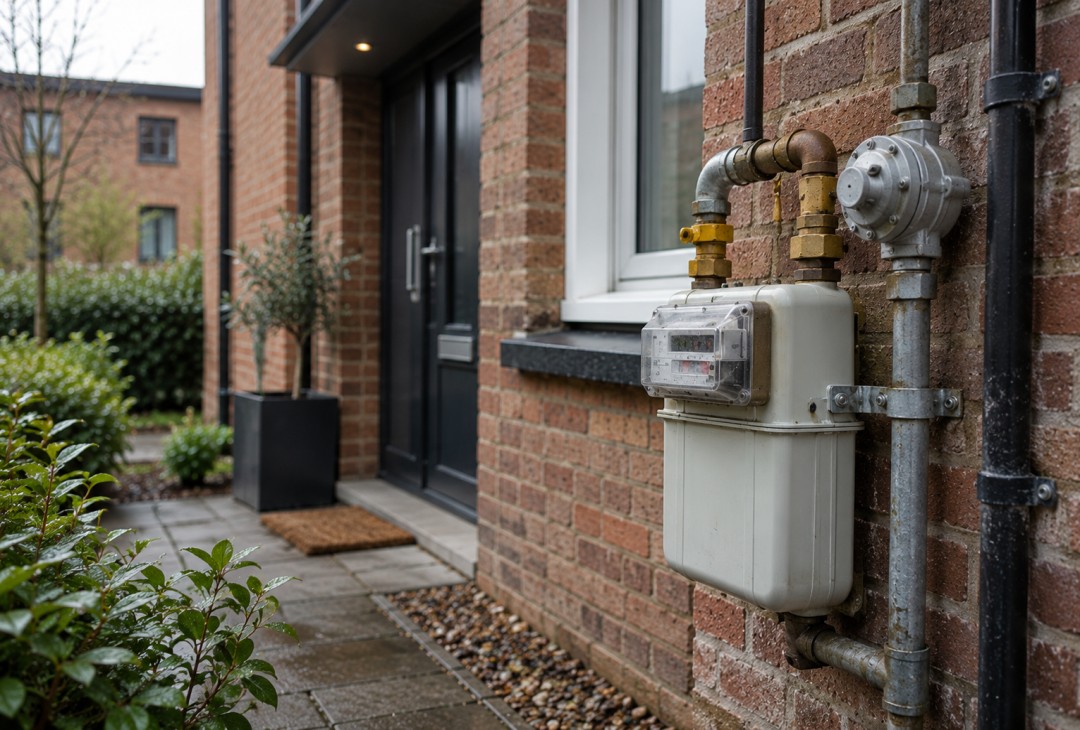
Start with a short walk around the building. Cadent lists garages, under the stairs, kitchens and outside walls as common spots, and in multi-occupancy buildings the meter is usually inside, sometimes in a communal area.
Where to look | What you may find | Often seen at |
Outside wall | A lockable meter box, sometimes built into the wall | Shops, offices, units with street access |
Cupboard, under the stairs or kitchen | A meter beside the incoming pipe | Small offices, cafés, converted buildings |
Plant room, boiler house or basement | A larger meter, often with a corrector | Hotels, big kitchens, industrial units |
Communal area or riser | Several meters side by side | Multi-occupancy buildings |
Check the Gas Meter is Yours
In shared buildings, look for a label with your unit number, then match the MPRN to your address before you read anything. Every meter has its own MPRN, so reading a neighbour's meter is an easy mistake. Our guide to business gas meter types explains the size label (U6, U16 and so on) you may spot on the data badge.
Open the Box Safely
Under the Gas Safety (Installation and Use) Regulations 1998, a locked meter box should come with a labelled key for the consumer, so someone has it. Ask your landlord, agent or the previous occupier, and never force the lock. Once it is open, keep it clear: the same regulations bar storing readily combustible materials in a meter box. Also note the emergency control valve, which in many boxes is a red lever near the pipe, so your team knows where it is.
Safety first: if you smell gas, leave the area and call the National Gas Emergency Service on 0800 111 999. Do not carry on with your reading.
Step 2: Finding the MPRN
The MPRN, or Meter Point Reference Number, is a unique reference for each gas supply point. Think of it as the address of your supply: it stays with the premises whichever supplier you choose. It is not the meter serial number, which identifies the device itself. Expect between six and ten digits, and numbers only.
Where to Look
A recent bill. Look for "Meter Point Reference" in the details of charges. Paperwork left by the previous occupier is worth checking, and a letter addressed to "The Occupier" may carry the number too.
The meter itself. Some installations print it on the meter, though many do not.
Find My Supplier. Search your postcode on findmysupplier.energy to see your address, MPRN, gas supplier and gas transporter.
The Meter Number Helpline. If the online search draws a blank, call 0870 608 1524.
Our MPRN explainer covers more methods if these fail.
When No MPRN Appears
If the building is new, or pipework exists but no meter does, there may be no registered meter point yet. Your gas transporter can arrange a live or dead check and, where needed, create an MPRN before a supplier fits the meter. Northern Gas Networks describes that route, and E.ON notes that creating an MPRN can take several weeks, so start early. If a meter is already fitted but has no MPRN, contact a supplier and ask to register the supply.
Step 3: Taking the Opening Reading
Your opening reading is the snapshot that says where the meter stood when the premises became yours. Take it on the day you become responsible. British Gas asks for a reading as soon as you start being legally responsible, and Citizens Advice suggests photographing it on day one, even if the meter is smart.
How to Read Each Gas Meter
Gas meter records volume, in cubic metres (m³) or cubic feet (ft³). Read the digits from left to right, ignore any shown in red, and keep every zero.
Meter type | Units | What to record |
Digital metric | m³ | The black digits only, usually five |
Digital imperial | ft³ | The black digits only, usually four |
Dial | ft³ or m³ | The first four dials, left to right, ignoring red and oversized dials |
Corrector fitted | Corrected volume | The "Corrected total", with every digit shown |
Smart | m³ | The main consumption figure on the display, plus a photo |
Send It Where It Counts
Give the reading, the date and your photo to the supplier on the meter and to the one you choose. Expect to show proof you are moving in, such as a lease, a business rates statement or a solicitor's letter.
Step 4: Agree a Contract Before Deemed Rates Add Up
With the meter found, the MPRN noted and the reading logged, you can act. Use Find My Supplier to confirm who is on the meter and tell them you have moved in. Ofgem advises arranging a contract before you move in where you can, and at any point after if not. Until the change of tenancy is processed, a switch request can be rejected, so send your opening reading and proof of occupancy first.
What Deemed Rates Look Like
Each supplier publishes its own deemed rates. EDF's schedule effective 1 September 2026 lists a unit rate of 12.548p per kWh and a standing charge of 1,015.13p a day, both before VAT and the Climate Change Levy. Our October guide on LNG and the UK natural gas price cites a British Gas Business deemed rate of 15.01p per kWh from May 2026, and an average one-year fixed rate for a small business of 10.4p per kWh in October 2026.

If your usage is steady, each month on deemed terms costs about a twelfth of these figures. The volumes are illustrative, so use your own annual kWh to size the risk.
What Shapes Business Gas Prices
Ofgem's price cap does not cover businesses, so business gas prices move with wholesale markets, your usage, your credit position and your contract terms. When you compare commercial gas prices, weigh four things together: the unit rate, the standing charge, the contract length and any exit fees. Our business gas comparison shows estimates from panel suppliers, and comparing is free to you because supplier partners pay us when you switch.
Your New Premises Gas Checklist
Print this table and work down it on moving day.
When | Task | Keep as evidence |
Before the keys | Ask the landlord or agent for the meter key, the supplier's name and any recent bill | The email or letter |
Day one | Find the gas meter and photograph the box and its surroundings | A photo of the location |
Day one | Note the MPRN, and the meter serial number separately | A photo of the label or bill |
Day one | Read the black digits left to right, then photograph the display | A dated photo and a written note |
Day one | Send the reading and proof of occupancy to the supplier on the meter | Your lease, rates statement or solicitor's letter |
Within days | Compare gas contracts and agree one | The quote and contract terms |
First bill | Check billing starts from your opening reading | The bill beside your photo |
Five Mistakes That Cost New Occupiers Money
Reading the red digits. Only the black digits count, and any zeros stay in.
Quoting the serial number as the MPRN. Suppliers need the MPRN. The serial number belongs to the meter.
Waiting for the first bill. You are responsible for the gas you use before your contract starts, and a deemed rate can apply from then.
Reading the wrong meter. In shared buildings, match the MPRN to your address first.
Skipping the photo. A dated photo gives you evidence if a bill is questioned, and Citizens Advice recommends one even with smart meters.
Frequently Asked Questions
Here are answers to the questions we hear most often.
Where is the gas meter in a commercial building?
It is often in an outside meter box, a cupboard, a plant room or a basement, and in shared buildings it may sit in a communal area. Check your lease or handover pack, then ask your landlord or agent for access and the key.
What is an MPRN, and is it the same as the meter serial number?
No. The MPRN is a unique reference for the gas supply point at your premises, usually six to ten digits. The serial number identifies the meter itself. Suppliers need the MPRN to quote and to switch.
When should I take the opening reading?
On the day you become responsible for the premises. Photograph the display, note the date, and send both to the supplier on the meter and to the supplier you choose.
What happens if I do not agree a gas contract when I move in?
You are likely to be placed on a deemed rate contract, which is variable and usually costs more than a negotiated fixed deal. You can usually switch away once the change of tenancy is processed, but you remain responsible for the gas you use until your new contract starts, as Ofgem explains.
Are business gas prices capped?
No. Ofgem's price cap covers households, not businesses. Commercial gas prices depend on wholesale markets, your usage, your credit position and your contract terms, so comparing quotes matters.
Final Words
Moving into new premises brings a hundred small jobs. Three of them take minutes and protect you from weeks on deemed rates: find the gas meter, note the MPRN and take a dated opening reading. Do those first and everything after, from quotes to your first bill, runs more smoothly.
The next move is price. A quick comparison of business gas prices can put you on a fixed deal instead of a deemed rate, and SwitchUrEnergy will do the comparing for you. Get your gas quote in a few minutes, or call (0203) 9500885, Monday to Friday, 9am to 5pm.
This article is general information, not financial advice. Compare quotes against your own usage before you sign.