
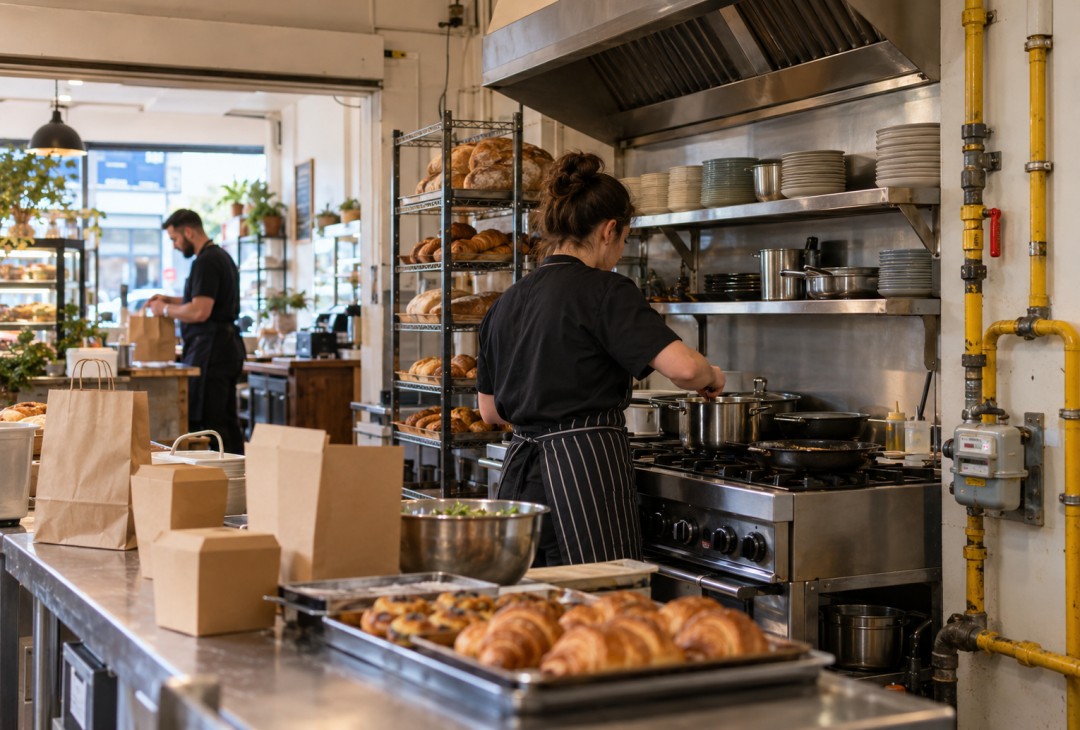
If your ovens barely switch off, you know the feeling. The gas bill lands, you scan the total, and you wonder whether the rate is fair or whether you are paying more than the kitchen next door.
Restaurants, bakeries and takeaways burn gas differently from offices and shops. Ranges run all service, deck ovens heat before dawn, and fryers and wok burners work flat out at the weekend peak. That makes the best business gas rates a moving target. The right deal for a 20,000 kWh takeaway is not the right deal for a 60,000 kWh bakery.
This guide explains what a good rate looks like in October 2026, how British Gas, Scottish Gas and other suppliers fit in, and which steps protect your margin. You will find benchmark tables, worked examples, two graphics, practical tips and an FAQ.
What counts as the best business gas rates in 2026?
There is no single answer. Businesses get no Ofgem price cap, so business gas prices are negotiated and depend on your usage, location, credit profile, contract length and the day you sign. Wholesale gas has also been volatile since the Gulf conflict disrupted LNG supply, as our UK natural gas price guide explains.
October 2026 benchmarks
Published averages disagree because each one measures something different. Read them as a range, not a promise.
Source | What it measures | Published rate (per kWh) |
|---|---|---|
Average fixed rate, Bionic panel, 1 to 8 September | Micro 8.8p, small 8.5p, medium 8.7p, large 8.6p | |
Average fixed rate, 1 January to 12 October | Micro 9.4p, small 9.0p, medium 9.2p | |
Average one-year fixed rate, October | 11.5p (10,000 to 50,000 kWh), 11.0p (50,000 to 100,000 kWh) | |
Average out-of-contract rate, MoneySuperMarket, 8 September | 12.0p |
Use the panel averages as your marker for a strong fixed rate, treat anything above 10p as a reason to ask questions, and read 12p as a warning light. Only a live quote for your meter, postcode and usage gives your real figure.
Most restaurants, bakeries and takeaways use far less than 293,000 kWh of gas a year, so Ofgem treats them as microbusinesses. That means suppliers must show current prices and annual consumption on renewal letters, which helps you compare like for like.
Unit rate, standing charge and the extras
The unit rate is only half the bill. The standing charge is a daily fee whatever you use, and the same panel averages 49.5p a day for small sites and 67.3p for medium ones. Then come the Climate Change Levy, 0.801p per kWh from 1 April 2026, and VAT.
Here is a check many kitchens miss. If your gas use averages no more than 145 kWh a day at one premises, about 4,397 kWh a month, HMRC treats it as low-use supply with 5% VAT instead of 20%, and the levy normally does not apply. A takeaway using 20,000 kWh a year averages about 55 kWh a day, well under the limit. If your bill shows 20% VAT, ask your supplier or accountant why.
How restaurants, bakeries and takeaways use gas differently
Same fuel, different kitchens. Use this table as a practical guide, not a benchmark, because equipment, hours and layout change real usage.
Business | Where the gas goes | What to check in your quote |
|---|---|---|
Restaurant | Ranges, grills, ovens and hot water, plus winter heating | Seasonal use, and whether a refit or lease change could shorten your term |
Bakery | Deck or rack ovens heated before trade, often overnight | Annual kWh rather than opening hours, and whether unit rate or standing charge matters more at your volume |
Takeaway | Fryers, wok burners and grills working hard at evening and weekend peaks | Standing charge and size band, plus a fixed end date so a takeover or renewal never drops you onto deemed rates |
What a poor contract really costs
Numbers make the point faster than advice. This chart compares the unit cost of gas for three illustrative sites on a fixed rate, an out-of-contract rate and a deemed rate.

Unit cost only, before standing charge, Climate Change Levy and VAT. Fixed: 8.5p (small band) and 8.7p (medium band), MoneySuperMarket panel averages, 1 to 8 September 2026. Out of contract: 12.0p, the average cited in our September guide. Deemed: 15.01p, the British Gas Business rate from 24 May 2026, as reported in our September guide. Usage figures are illustrative.
A takeaway using 20,000 kWh pays around £700 more a year out of contract than on a fixed 8.5p, and about £1,300 more on deemed rates. For a bakery using 60,000 kWh, the gaps widen to roughly £1,980 and £3,790. Deemed rates apply when you move into premises without agreeing a contract, and out-of-contract rates follow when a fixed deal ends with no renewal.
Why the standing charge can flip the answer
The cheapest unit rate is not always the cheapest bill. Our September guide compared two two-year fixed benchmarks from Love Energy Savings: British Gas at 9.3p per kWh with a 48p daily standing charge, and British Gas Lite at 9.5p with 23.1p a day. At 20,000 kWh, British Gas Lite works out about £51 cheaper. The two cross at roughly 45,400 kWh, so a bakery using 60,000 kWh would be about £29 better off with standard British Gas. Small sites should weigh the standing charge heavily and larger sites the unit rate. These are benchmarks, so live quotes will differ.
British Gas, Scottish Gas and the rest of the market
Here is the key information about the renowned UK energy company.
Are British Gas and Scottish Gas the same company?
Yes. Scottish Gas is the name British Gas trades under in Scotland, and both belong to Centrica. Do not confuse it with ScottishPower, which is a separate supplier.
What you can see up front
British Gas Business offers fixed plans from one to three years, and British Gas Lite is a fixed-price, online-only product for small businesses that pay by Direct Debit. British Gas Business does not publish the fixed gas rates it offers new customers, so you need a quote to see what your site would pay.
What our comparison shows
Here are the five cheapest of the ten quotes on our gas comparison for a 10,000 kWh site, excluding VAT.
Supplier | Plan | Term | Estimated annual bill |
|---|---|---|---|
TotalEnergies | Fixed | 2 years | £809.14 |
EDF Energy | Fixed | 3 years | £864.25 |
British Gas Lite | Fixed | 3 years | £880.29 |
Yu Energy | Fix Energy Plan | 2 years | £884.48 |
British Gas Lite | Fixed | 4 years | £891.75 |
Across all ten quotes, annual bills ran from £809 to £1,022, a £213 gap on identical usage. Longer was not automatically cheaper either: TotalEnergies' two-year deal beat its four-year deal by about £111. The page was last updated on 11 August 2026, so read this as a guide to the spread, not a live quote.
Choosing the right contract length for your kitchen
The rate is one half of the decision, and the term is the other. Fixed contracts usually run from one to five years and shield you from price swings, but they can carry exit fees if you close, refit or relocate.

Contract length guide based on advice from EnergyPlus and MoneySuperMarket. Compare real quotes at each term.
A long fix suits a secure lease, stable hours and no refit on the horizon. A shorter or flexible deal suits a new site, a refit or a first year of trading, and some flexible tariffs allow just 30 days' notice. Business gas contracts also usually have no cooling-off period, so read the term, notice and exit terms before you sign. Because longer is not always cheaper, ask for quotes at two or three terms.
Taking over a kitchen? Without a contract you are normally placed on deemed rates, so use our new premises checklist to find the meter, MPRN and opening reading on day one.
How to secure the best business gas rates
Here are the seven practical ways.
Before you compare
Know your numbers. Have your annual kWh, meter type and MPRN ready. Our MPRN guide shows how to find it without a bill, and our meter types guide explains the size label on your meter.
Diarise your renewal window. Start comparing three to six months before your contract ends, as MoneySuperMarket advises. British Gas Business, for example, writes around 60 days before a fixed plan ends.
While you compare
Compare like for like. Use the same term, payment method and treatment of levy and VAT, then do the full sum: kWh × unit rate, plus the daily standing charge × 365.
Check your VAT rate. Use the 145 kWh a day test above before you accept 20%.
Read the small print. Check exit fees, notice periods and auto-renewal terms before you sign.
After you switch
Use less gas, safely. HSE catering guidance points to Gas Safe registered engineers, and councils commonly advise annual inspections of appliances, flues and ventilation. Beyond that, switch burners off between services, match pan size to burner and load ovens fully before firing. Never switch off extraction linked to a gas interlock. The Carbon Trust hospitality guide has more ideas.
Keep your meter evidence. Photograph the meter on your switch date and check your first bill against it, so you only pay for your own gas.
How SwitchUrEnergy helps you compare business gas rates
Comparing suppliers takes time you do not have between services. SwitchUrEnergy does the legwork. Tell us your postcode, usage and meter details, review personalised quotes side by side on our business gas comparison, and we manage the switch, which typically completes in two to six weeks. Our panel includes British Gas, British Gas Lite, Crown Gas & Power, E.ON Next, EDF, ScottishPower, Smartest Energy, TotalEnergies, Utilita and Yu Energy.
Comparing is free to you. Our supplier partners pay us when you switch, and we show the contract term and any exit fees before you commit. Your kitchen runs on electricity too, so compare business electricity at the same time.
Get your business gas quote, or call (0203) 9500885, Monday to Friday, 9am to 5pm.
Frequently Asked Questions (FAQs)
Here are answers to the questions we hear most often.
What are the best business gas rates for a restaurant right now?
It depends on your usage, postcode and meter. October 2026 panel averages for fixed deals sit around 8.5p to 8.8p per kWh, other trackers show one-year fixes above 11p, and out-of-contract rates average around 12p. Compare live quotes before you sign.
Is there a price cap on business gas?
No. Ofgem's cap covers households only. Business rates are negotiated, which is why comparing matters.
Are British Gas and Scottish Gas the same?
Yes. Scottish Gas is British Gas's trading name in Scotland, and both are part of Centrica. ScottishPower is a different company.
What happens if I take over a kitchen without a gas contract?
You are likely to be placed on deemed rates, which cost more than a negotiated fixed deal. Take an opening meter reading on day one, then compare and agree a contract quickly.
Can a bakery or takeaway pay 5% VAT on gas?
Yes, if gas use averages no more than 145 kWh a day, about 4,397 kWh a month, at one premises. Above that, the standard 20% applies. Check your bill and ask your supplier if the rate looks wrong.
Will switching interrupt my gas supply?
No. The gas still arrives through the same pipes, and only your supplier, contract and billing change.
Does it cost anything to compare with SwitchUrEnergy?
No. Comparing is free to you, and we earn from supplier partners when a customer switches.
Final Words
The best business gas rates are not one headline number. They depend on your kitchen, your volume, your term and the day you sign. Aim for the strong end of your size band, do the full sum including the standing charge, check your VAT, and never let a contract drift onto out-of-contract or deemed rates.
Ready to see where your restaurant, bakery or takeaway stands? Get your business gas quote in a few minutes, or call (0203) 9500885. Comparing is free, and our team will talk you through your options before you decide.
This article is general information, not financial advice. Compare quotes against your own usage before you sign.